Showing posts with label adult. Show all posts

Sunday, 11 September 2016

, , , ,

Victor Hugo: Les Misérables - review

7444576Author: Victor Hugo
Publish Date: 1862
Genre: Epic, historical
Audience: Adult fiction


(N.B. This review contains plot descriptions which may contain minor spoilers - but who hasn't seen the film/musical before reading this, right?)

Ever since I fell in love with the stage show, and subsequently film, it has been a goal of mine to read the epic that is 'Les Misérables'. Therefore, this summer I decided to finally embark on the journey, and surprisingly, it didn't take me as long as I had imagined - only 17 days! In fairness, I was reading 70 long, small-print pages per day, but it was completely and utterly worth it.

One thing I adored about 'Les Misérables' was that the plot has the perfect balance of dramatic action and tranquil romance. Cleverly, this is interwoven through nearly all of the prominent characters, Marius being the most obvious. This makes the plot very character-driven, rather than a situation to which the protagonists are merely responding to - a plot type which I am not that familiar with, but one which I thoroughly enjoyed. In addition, there were quite a few scenes which I was unfamiliar with (as they had been cut out of other adaptations), but ones which added much more character depth; for example, Fantine's past before working in the factory was elaborately described, allowing the reader to get a better sense of her personality and nature. This also made her death a lot more emotive as you have connected with her character on a much deeper level.

In terms of character descriptions, these were outstanding. Physically, emotionally, motives - everything was covered. As mentioned above, this allows a much deeper connection between character and reader to be established, a feature that is extremely important towards the story of 'Les Misérables'. Furthermore, having such well-formed characters inevitably leads to superb development; Jean Valjean's evolution from selfishness to putting both Cosette and Marius before himself is one of my favourite examples, along with the internal, moral struggles faced by Javert.

Yet another thing Victor Hugo must be praised for is his use of extremely emotive language. Whether it be descriptions of characters, feelings, or scenery, it is all unbelievably beautiful. As a reader, it makes the reading experience entirely immersive, particularly with the embellished illustrations of both settings and emotions. In addition to pages of stunning description, Hugo has extreme talent at writing such powerful statements that really make you sit and go - 'wow'. As a result, every time I updated my reading progress on Goodreads, I would pick out a sentence which had enthralled me most and document it there so I had a neat collection of my most favourite quotes to look back on.

My one and only criticism with 'Les Misérables' is that Victor Hugo does have the tendency to dedicate whole books* to topics which could be considered off topic. For example, when Jean Valjean enters the sewers carrying an unconscious Marius, Hugo breaks away to give a 15-page description of Paris's sewer system, explaining how and why it's developed over the course of 30 years. Overall, quite irrelevant. I would say that Hugo does this around 5 or 6 times throughout, meaning around 1/10 of the book is filled with these monotonous and repetitive ramblings. However, to give him some credit, I can see the reasoning as a majority of these rants are aimed at criticising some aspect of society, which overall is Hugo's motive with 'Les Misérables'.
* 'Les Misérables' is split into 5 large parts, each including around 8 books, which then have their own smaller chapters.

In conclusion, 'Les Misérables' is truly deserving of its epic status. Throughout my read, I was dithering whether to give it 4 or 5 stars as the 'irrelevant' rants are a struggle to read at times; however, the last 100 pages were so unbelievably outstanding that in the end I couldn't bear to give it any less than 5 stars. Victor Hugo absolutely nails everything you could want out of a novel - from stunning descriptions of every kind, to well-established and connectable characters, to a thrilling and engaging plot, 'Les Misérables' is a sincerely incredible novel.

Next read: 'How Hard Can Love Be?' by Holly Bourne


Continue reading Victor Hugo: Les Misérables - review

Monday, 22 August 2016

, , , ,

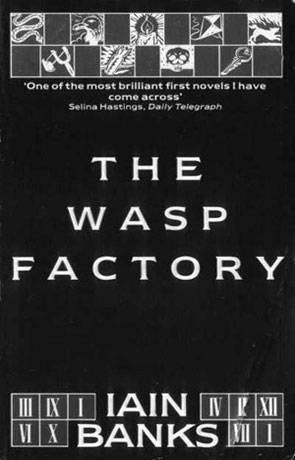
Iain Banks: The Wasp Factory - review

Author: Iain Banks
Publish Date: 16 February 1984
Genre: Horror, gothic
Audience: Adult fiction


(N.B. This book deals with heavy and potentially upsetting issues such as animal torture and mental illness. Grotesque imagery is also used frequently - this is not for the fainthearted!)

'The Wasp Factory' was recommended to me by my English Literature teacher as part of my A2 coursework. At first, I had no idea how this novel could possibly relate to my chosen topic of masculinity, but I was pushed to wait for the end..and now it makes perfect sense.

Throughout my time reading 'The Wasp Factory', I was very unsure how I felt about it. In some places, the writing is spectacular; in others, it fails to deliver. Whilst the novel is a short read as it is, I believe it was heavily padded out with mundane descriptions of Frank's daily activities which bared no real significance to the plot. This made it a difficult read to begin with as I was unsure on the importance of these details, but in the end they proved to be a waste of time, and an effort to trawl through. However, in the last twenty pages or so, Banks upped his writing game immensely, with gripping narrative and an extreme amount of tension.


Something else that made this novel a struggle to get through was my intense dislike towards the protagonist Frank. Having committed unforgettable crimes, whilst having a passion for torturing wasps and collecting animal corpses - he's not the friendliest of people. As a reader who prefers characters they can relate with, this certainly (but fortunately!) didn't resonate with me, and it was hard to feel any sympathy for Frank and his family. In addition to this, the violence and gore depicted so calmly by Frank honestly scared me a little; the peculiarity and horror of the situations did not seem to faze him in the slightest which made for a chilling experience. Although, I do suppose a novel which can cause that reaction from a reader must be commended for its atmosphere and disposition.

However, one thing that I did enjoy was my overall understanding of the novel once I had finished it. The ideas centring around sexuality and gender were extremely compelling, and some which I am excited to explore in my coursework. This was probably because I was analysing the novel in more detail than I would have done if this wasn't for my A Level, but nevertheless it was an interesting insight into the world of masculinity. Therefore, for something I would not usually pick up, I was pleasantly surprised by the plot and theme as a whole.

It is a wonder I didn't give 'The Wasp Factory' 2 stars after my generally negative review; however, in my opinion the ending deserves a star all for itself. This novel is an extremely bizarre read, featuring gruesome topics and chilling characters, but with an overall thought-provoking message. I don't think I would have enjoyed this novel as much if it wasn't relevant to my coursework, but in the end it was a fairly satisfying read none the less.

Next read: 'Everything, Everything' by Nicola Yoon


Continue reading Iain Banks: The Wasp Factory - review

Thursday, 9 June 2016

, , , ,

Bernhard Schlink: The Reader - review

Author: Bernhard Schlink
Publish Date: 1995
Genre: Realism
Audience: Adult fiction

I actually finished this book around a month ago but I have only now gotten round to writing about it! I decided to read 'The Reader' as it was part of my wider reading list for English Literature, and the theme of forbidden love is one that I typically enjoy.

However, this novel offered me so much more than I could have ever wanted. The story is set in war time Germany and features heavy content surrounding the Holocaust. Nazi Germany is a period of history which I find absolutely fascinating, and so this made the book a lot more engaging for me.

Another aspect I really enjoyed about 'The Reader', is its structure. The novel is set out in three parts, and each part is extremely distinct - part one follows Michael's affair with an older woman named Hanna; part two follows a trial which convicts Nazi officers of their doings in the Holocaust; part three portrays Michael as an older man and his connections with his past lover Hanna. This structure made the book unique for me, but also added interest. In addition, each chapter is relatively short so the story is fast paced but still easy to follow.

The characters of Michael and Hanna are extremely real, helped by the superb writing of Bernhard Schlink. I felt empathy for both as the novel takes an unexpected turn, and moments in the third part are extremely touching for multiple reasons. The author also takes - to an extent - an intrusive role at times, which questions the morals of both forbidden love and the Holocaust, giving the reader a much more immersive and engaging role instead of the usual back-seat observer.

Overall, I thoroughly enjoyed 'The Reader' for a multitude of reasons; the writing, the character development, and the plot were all truly superb. It provided an exceptionally captivating experience as I was forced to evaluate the rights and wrongs of a devastating incident, whilst following an intriguing love story between two very different people.

Next read: 'Legally Blonde' by Amanda Brown
Continue reading Bernhard Schlink: The Reader - review

Friday, 6 May 2016

, , ,

Zoë Heller: Notes on a Scandal - review

Author: Zoë Heller
Publish Date: 5 June 2003
Genre: Realism
Audience: Adult fiction


I chose to read this novel as it was featured on the 'Wider Reading' list for my English Literature AS due to its central theme of forbidden love. The strong focus on a student/teacher relationship is contrasted with the protagonist's suppressed lesbianism, and both topics considerably took my interest throughout the novel.

One of my favourite parts about this novel is the way the story is told. Despite focusing on the relationship between teacher Sheba and her student Steven Connolly, the tale is solely narrated through Sheba's close friend and colleague Barbara; this form of narrative allows a vast amount of bias to creep through, making the novel both humorous and subject to interpretation. It also manages to create dramatic irony through the characters' actions which adds immediate depth to the novel's plot.

Another aspect of 'Notes on a Scandal' which really grabbed my attention was the quality of writing. Not only did it carry the story effortlessly, it had me hooked from the beginning to the very end as it weaved flashbacks with the present, and cruel realities with idealised fantasies. The situations which the characters' are faced with are extremely intriguing, and make you stop and think about the morality and integrity surrounding them.

What let me down, however, was the ending - don't worry, I won't give any spoilers. The last chapter or so entailed a predictable and inevitable ending, and the climatic section was incredibly enthralling despite, as a reader, knowing the outcome from the beginning. However, the novel ended on a particularly ambiguous note which didn't exactly leave me wanting more, only frustrated at its anti-climatic nature.

Having said that, the last few lines were very intriguing; for most, a whole new theory is uncovered which perhaps changes the atmosphere of the whole novel. I possessed knowledge of this aspect before I began reading, and I could definitely recognise moments which backed up this notion - for those concocting their own theory at the end, I highly suggest a re-read.

Overall, 'Notes on a Scandal' was an enjoyable quick read in which theories were conjured up and morals were thoroughly questioned. The anti-climatic ending did spoil the overall aura to a certain, albeit small, extent; however the writing style and narrative is absolutely superb and completely satisfies this intriguing tale.

Next read: 'The Reader' by Bernhard Schlink


Continue reading Zoë Heller: Notes on a Scandal - review